
GPT Image 2 Education Visuals: Courseware, Infographics & Multilingual Assets
July 2026: Batch course covers, teaching infographics, storyboard panels and multilingual courseware with gptimage 2 Thinking mode prompts.
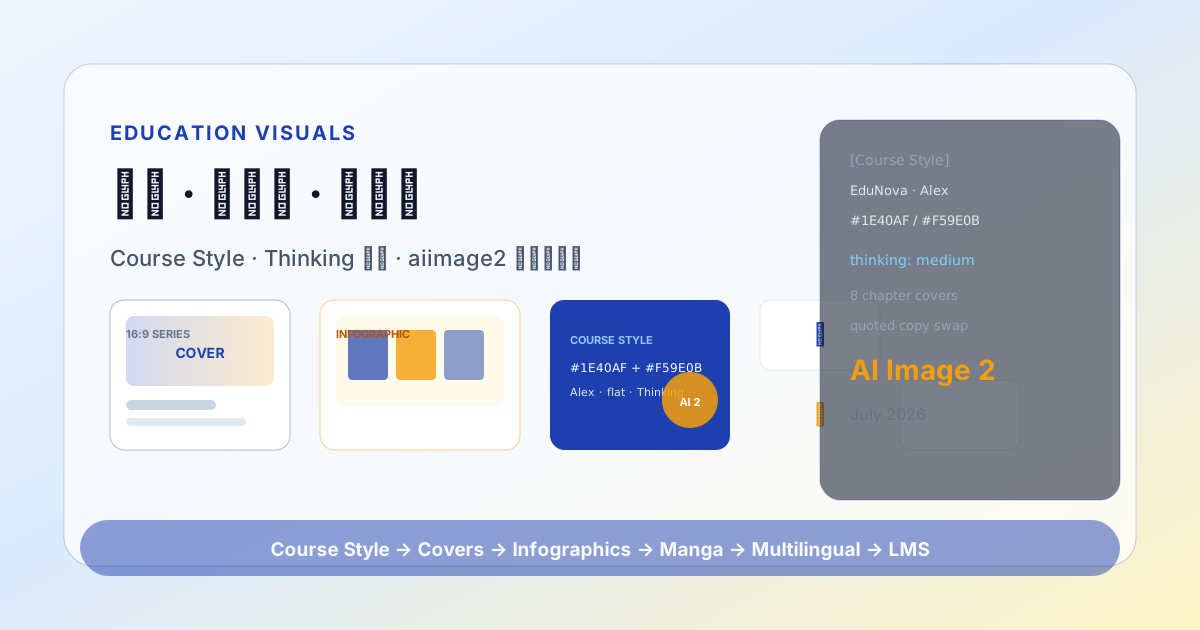
From course kickoff to launch, visual assets often consume 30%–40% of the timeline: covers, chapter headers, concept infographics, exercise illustrations, promo posters, multilingual versions… In the traditional flow, illustrators + graphic designers + localization teams work in series — changing one chapter title can mean redrawing half a set.
GPT Image 2 (site shorthand gptimage 2) shines in education by baking text rendering, layout planning, and multi-image coherence into Thinking mode workflows — ideal for high-information-density AI image generation with labels and multilingual swaps. This playbook reflects July 2026 practice from K12, vocational training, and MOOC teams — a reusable education visual pipeline.
Why education teams need gptimage 2
| Pain point | Traditional approach | With GPT Image 2 |
|---|---|---|
| Inconsistent chapter covers | Multiple vendors, hard to align | Thinking mode plans 8 covers in one series |
| Infographic typos | Fix text in PS later | Text rendering generates titles/data labels |
| Abstract concepts hard to show | Text-only or stock photos | Prompt description + step diagrams |
| Multilingual courseware | Reflow + redraw | Swap quoted copy only, layout fixed |
| Manga/storyboard teaching | Character inconsistency | Locked character descriptor + reference edits |
| Compliance & copyright | Misuse celebrities/trademarks | Brand Block + forbidden list |
gptimage 2 does not replace instructional design — it shifts ID and visual teams from “commission each image” to templated batch + human review.
Which education assets fit GPT Image 2
| Asset type | gptimage 2 fit | Notes |
|---|---|---|
| Course/module covers | ★★★★★ | 16:9 / 1:1, series of 8 |
| Concept infographics / flowcharts | ★★★★★ | Thinking + zone labels |
| Chapter headers / transition slides | ★★★★★ | Same Course Style as covers |
| Teaching manga / 4–8 panel storyboards | ★★★★☆ | Character lock + Thinking |
| Data charts (illustrative) | ★★★★☆ | Human must verify numbers & sources |
| Lab/equipment diagrams | ★★★★☆ | Scientific accuracy needs expert review |
| Dense formulas/code screenshots | ★★☆☆☆ | Prefer LaTeX/IDE screenshot overlay |
| Print-ready textbook pages | ★★★☆☆ | Needs 300dpi + vector type supplement |
Build Course Style block
Maintain Course Style in Git or Notion — paste atop every gptimage 2 request:
[Course Style]
Institution: EduNova Academy (sample)
Audience: 18–25 career newcomers
Primary: #1E40AF (blue) + #F59E0B (amber accent)
Style: flat illustration + light 3D icons, friendly, not childish
Type feel: rounded sans-serif, bold headlines, Regular labels
Character (if any): mentor Alex — short hair, glasses, navy cardigan, consistent throughout
Forbidden: unauthorized brand Logo, real celebrity faces, medical/investment promise language
[Output] 2048px long edge; 12% safe margin; sRGB
Stable Course Style makes cross-chapter, cross-language AI image generation feel like one course.
Standard workflow
Step 1: Module cover series (Thinking mode)
Generate 8 chapter cover series for "Python Data Analysis Intro" MOOC.
Thinking mode: list 8 compositions first (center icon, split columns, isometric grid…),
unify Course Style primary #1E40AF/#F59E0B, reserve 25% height for chapter number and title.
Chapter 3 title in quotes: "Data Cleaning & Missing Values"
Subtitle: "Pandas in Practice"
Flat illustration, no real brand Logo, 16:9.
Pick one as Master Cover; keep the rest as alternates.
Step 2: Concept infographics
Teaching infographic: explain relationship among training set, validation set, test set.
Three-column layout, column titles in quotes: "Training Set" "Validation Set" "Test Set",
two lines of explanatory text below each, bottom summary line "Split before you tune".
Course Style palette, Thinking mode, 4:5 portrait, educational infographic style.Important: Data, ratios, and terminology must be human-verified by subject lead.
Step 3: Teaching storyboard (4-panel manga)
4-panel educational manga, same character Alex (short hair, glasses, navy cardigan),
explaining "why split dataset before tuning", one short dialogue line below each panel,
clear lines, consistent character, Course Style background, Thinking mode.
API can use n: 4 or single Thinking output for multiple panels; split complex narratives into 2 requests.
Step 4: Multilingual courseware visuals
Keep layout and Course Style description unchanged; swap quoted copy only:
- English:
"Data Cleaning & Missing Values" - Japanese:
"データクリーニングと欠損値" - Spanish:
"Limpieza de datos y valores faltantes"
For Arabic and other RTL markets: prefer image-without-small-type + LMS localized overlay to avoid RTL layout errors.
Step 5: Review and ingest
- Facts & terminology: definitions, formulas, statistics, regulatory phrasing
- Readability: projection/mobile font size, contrast
- Accessibility: color-blind friendly (not color-only distinction)
- Naming:
MOOC_Python_Ch03_cover_v2_en.png - LMS / DAM ingest: link to chapter ID and prompt version
gptimage 2 + LMS / design tools
Recommended division of labor:
- Instructional Designer: learning objectives, scripts, Course Style
- Subject Matter Expert: infographic data & terminology final review
- GPT Image 2: cover series, infographics, storyboard mood & composition
- Designer: Logo overlay, complex charts, print PDF
- Localization: translate quoted copy only
Workflow example: gptimage 2 outputs Logo-free background layer → Figma stacks institutional ID and legal line → export to Moodle / Canvas / custom LMS.
Common failures
| Symptom | Cause | Fix |
|---|---|---|
| 8 chapter covers feel disjointed | Thinking off | Add “same MOOC series” + reduce prompt elements |
| Infographic numbers wrong | AI hallucination | Human supplies data table; disable web search or limit sources |
| Character doesn’t look like same person | Vague description | Course Style locks appearance; reference image edit |
| Chinese title typos | Instant mode | Switch Thinking mode; shorten quoted copy |
| Projection hard to read | Low contrast | Prompt high contrast; post-process outline |
Education KPIs
Beyond completion rate and satisfaction, track:
- Visual consistency score: curriculum lead blind-rates chapter images 1–5
- Production cycle: script freeze to full-chapter visual kit in days
- Rework rate: percentage rejected for fact/terminology errors
- gptimage 2 cost/course: API medium × image count + review person-minutes
Vocational training platform case (2026 Q2): 12-chapter MOOC visual kit (covers + infographics + 4-panel manga × 3 languages) dropped from 18 person-days to 5, blind visual score rose from 3.0 to 4.4 (5-point scale).
Team roles & governance
| Role | Responsibility |
|---|---|
| Course lead | Maintain Course Style, final visual tone sign-off |
| Subject expert | Infographic facts, terminology, compliance |
| ID / scriptwriter | Chapter briefs, quoted title strings |
| Visual / design | Master selection, Logo composite, print |
| Localization | Translate quoted copy — do not change layout |
| Engineering | gptimage 2 API batch, LMS webhooks |
Run a semester prompt library review: retire high-error templates; merge high-completion chapter structures.
Closing
GPT Image 2 shifts education visuals from “outsource by chapter” to 「Course Style + Thinking + multilingual quoted copy」 system mode — among the most practical AI image generation uses for course teams in 2026. Start with 1 pilot course (8 chapter covers + 3 infographics + 2 languages), run the SME review checklist, then expand to full catalog.
Further reading
Ready to create?
Jump to the App workbench and try GPT Image generation and multi-turn editing for free.
Start Creating Free →